
India’s tax system is entering a transformative phase with the implementation of the Income Tax Act, 2025 and the accompanying Income Tax Rules, 2026, both coming into force on 1 April 2026. While the headline tax rates remain broadly unchanged, the reforms introduce far-reaching structural, procedural, and compliance-related changes that will significantly affect Non-Resident Indians (NRIs).
Among these, one of the most visible shifts is the comprehensive redesign and renumbering of tax forms, alongside a broader move toward digitisation and real-time data monitoring.
This article sets out a clear, structured, and practical guide to what is changing and what NRIs need to do to stay compliant.
Highlights
From 1 April 2026, India’s new direct tax code is operational. For NRIs, the most important changes are:
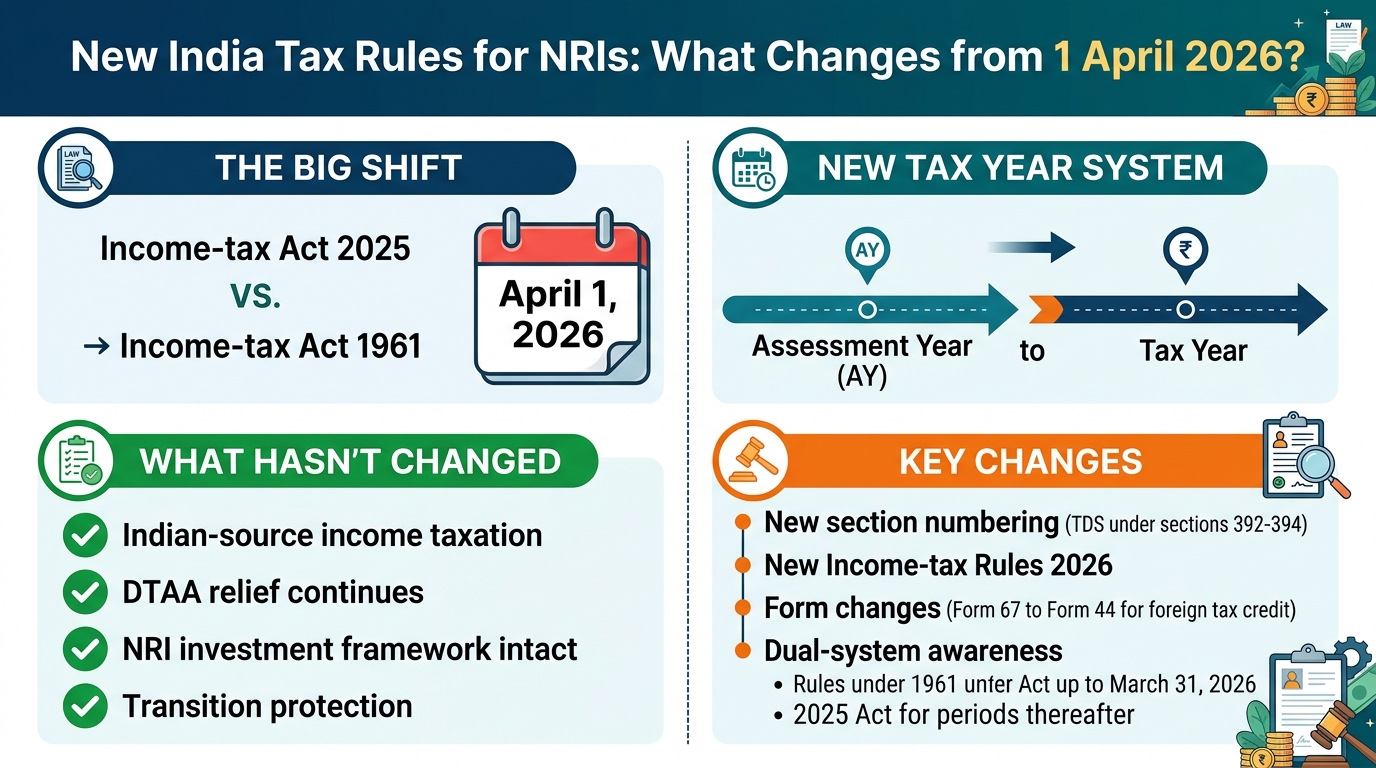
- The Income-tax Act, 2025 replaces the 1961 Act for income earned from 1 April 2026 onward.
- India has dropped the “Assessment Year” concept for the new law and now uses “Tax Year”.
- Core NRI taxability rules are broadly unchanged: NRIs are still taxed mainly on Indian-source income, and DTAA relief continues.
- Residential-status principles remain broadly continuous, including the existing framework around resident, non-resident, and RNOR concepts.
- TDS provisions have been structurally consolidated into new sections, especially section 393 for non-salary withholding.
- Transition rules are crucial: income up to 31 March 2026 stays under the old 1961 Act; income from 1 April 2026 falls under the new Act.
- A notable Budget/Finance Act 2026 compliance relief: for purchases of immovable property from an NRI seller, the resident buyer is proposed/introduced to deduct and deposit TDS using a PAN-based challan instead of obtaining a TAN, easing compliance significantly.
- New forms and compliance mechanics are being rolled out under the Income-tax Rules, 2026.
- The new law is presented as a simplification and modernization exercise, not as a wholesale increase in NRI tax burden.
In short: this is more of a structural and compliance reset than a fundamental re-taxation of NRIs. But for property transactions, withholding, filings, and cross-border reporting, the details matter.
Why 1 April 2026 Matters
India’s tax administration has formally confirmed that:
- the Income-tax Act, 2025 came into effect on 1 April 2026, and
- the Income-tax Rules, 2026 also came into force on 1 April 2026.
The CBDT’s transition FAQs make it explicit that the 1961 Act stands repealed from 1 April 2026, but continues to govern earlier tax periods through a savings and transition framework. That means India will effectively run two legislative tracks in parallel for some time:
- Old Act: for income periods up to 31 March 2026
- New Act: for income periods starting 1 April 2026
This matters greatly for NRIs because many cross-border tax issues do not end neatly on 31 March—property deals, TDS, refunds, lower withholding certificates, and return filing often spill across financial years.
The Big Shift: India Moves to a “Tax Year” System
One of the most visible changes is conceptual rather than monetary.
Under the old regime, taxpayers had to deal with:
- Previous Year, and
- Assessment Year
Under the new law, India uses “Tax Year” instead. The CBDT explains that this is intended to eliminate confusion caused by dual-year terminology.
What this means in practice
-
Income earned from 1 April 2025 to 31 March 2026
is still governed by the Income-tax Act, 1961, and filed as AY 2026–27. -
Income earned from 1 April 2026 to 31 March 2027
is governed by the Income-tax Act, 2025, and referred to as Tax Year 2026–27.
Why NRIs should care
If you are:
- receiving rent from Indian property,
- selling Indian real estate,
- earning Indian dividends or interest,
- claiming DTAA benefit,
- obtaining lower/nil withholding,
- filing an Indian return in 2026 or 2027,
you must now ensure you are referring to the correct law, correct year, and correct form set.
What Has Not Changed for NRIs
Despite the legal overhaul, several fundamentals remain broadly the same.
1. NRIs are still taxed mainly on Indian-source income
The basic rule remains: a non-resident is taxable in India only on income that is received, deemed received, accrues, arises, or is deemed to accrue or arise in India, subject to treaty relief.
2. DTAA relief still continues
India’s tax treaty network remains relevant. The Income Tax Department continues to state that a non-resident eligible under a DTAA can claim relief, subject to documentation such as a Tax Residency Certificate (TRC) and other prescribed details.
3. The special NRI investment taxation framework still survives
Search results from the Income Tax Department’s updated schedules and summaries show that the special rate structure for certain NRI investment income and long-term capital gains continues under the new framework.
4. Transition protection exists
Old rights and obligations do not vanish. Refunds, pending appeals, past-year assessments, and earlier tax positions continue under the savings provisions.
5. Core withholding and advance-tax mechanics remain familiar
The CBDT has clarified that the policy framework for TDS/TCS and advance tax is broadly unchanged, though the drafting and section numbering have been modernized.
What Has Changed for NRIs from 1 April 2026
Here are the changes that actually matter on the ground.
1. New law, new section numbering, new compliance references
The same concepts now sit in different sections. For instance, under the CBDT transition FAQs:
- TDS on salary is consolidated under section 392
- TDS on other payments, including many non-resident payments, is consolidated under section 393
- TCS is under section 394
This matters because:
- deductors must quote the new section/table item
- old references may trigger portal or validation errors
- professionals, banks, tenants, brokers, and property buyers dealing with NRIs will need updated compliance workflows
2. India’s new Income-tax Rules, 2026 are now operative
The notified rules came into force on 1 April 2026. These rules operationalize the new Act and introduce corresponding forms, procedures, and reporting formats.
3. The transition year requires dual-system awareness
The CBDT states that during this period:
- AY 2026–27 filings for FY 2025–26 will still be under the old Act
- advance tax and withholding for Tax Year 2026–27 will run under the new Act
For NRIs, this can create confusion unless carefully managed.
4. Certain compliance forms have changed
A notable example from EY’s summary of the new rules is that foreign tax credit documentation has shifted from Form 67 to Form 44 under the new framework for eligible taxpayers claiming foreign tax credit.
This is more directly relevant to residents claiming FTC, including returning Indians or RNOR/resident cases, but it is still important for globally mobile individuals moving in and out of NRI status.
5. Information systems and portal logic are changing
The tax department has explicitly said the portal will support compliance under both Acts in parallel. NRIs filing belated returns, revised returns, refund claims, or tax payments need to ensure they are selecting the correct:
- AY / Tax Year
- challan type
- law reference
- section code
Residential Status Rules: Is There a New NRI Residency Test?
This is one of the most searched questions—and one of the most misunderstood.
Short answer:
There does not appear to be a fresh NRI residency overhaul from 1 April 2026.
The new Act reorganizes and simplifies the law, but currently available official material suggests continuity, not a radical rewrite, of the underlying residential-status framework.
The Income Tax Department’s updated “Residential Status” guidance continues to reflect familiar categories:
- Resident
- Resident but Not Ordinarily Resident (RNOR)
- Non-Resident
It also continues to reference the deemed resident/RNOR architecture already known from earlier law.
So what should NRIs conclude?
Do not assume that 1 April 2026 created a brand-new 120-day or deemed-resident regime. Those concepts were already part of the pre-2026 framework. What changed is primarily:
- statutory presentation,
- section numbering,
- drafting style,
- administrative operation under the new Act.
Practical advice
If you are:
- spending extended time in India,
- returning to India after working abroad,
- splitting time between India and the Gulf/US/UK/Singapore,
- drawing Indian investment income,
you should still compute your residential status carefully for each relevant year using the updated rules and current thresholds.
NRI Income Still Taxable in India: Key Categories
From a practical standpoint, the following Indian-source income heads remain the main exposure points for NRIs:
1. Rental income from property in India
Taxable in India. TDS obligations continue where applicable, and return filing may be necessary.
2. Capital gains on sale of Indian property
Still taxable in India. Buyer-side withholding remains a major issue, though compliance is now being eased operationally for resident buyers purchasing from non-residents.
3. Interest income
For example:
- NRO account interest
- certain Indian securities or deposits
- debentures or bonds, depending on instrument and treaty position
Taxability and rates remain subject to the Act plus treaty relief.
4. Dividend income from Indian companies
Taxable in India in the hands of the shareholder, with DTAA relief where applicable.
5. Business income connected with India
Income attributable to a business connection, source, or property in India remains within the tax net, and the new rules also continue provisions for determination of income in the case of non-residents where exact income is not readily ascertainable.
6. Income deemed to accrue or arise in India
This remains a major anti-avoidance and source-rule area, especially for cross-border structures, indirect transfers, royalties, fees for technical services, and digital nexus issues.
TDS and Withholding After 1 April 2026
The structural change
The CBDT states that the old patchwork of TDS sections has largely been consolidated into the new Act, especially into section 393 for non-salary payments.
What stays the same
The department says the rates and thresholds are largely the same, with exact rates to be read with the applicable Finance Act.
Why this matters for NRIs
Many NRI tax obligations are experienced first through withholding, not final assessment. Common examples:
- buyer withholding on property purchase from an NRI
- bank withholding on NRO interest
- tenant withholding on rent
- withholding on dividends, royalties, or other sums chargeable in India
Transition rule
The CBDT’s FAQ gives a clear principle:
- If the payment or credit happened on or before 31 March 2026, the 1961 Act applies.
- If the payment or credit happens on or after 1 April 2026, the 2025 Act applies.
This is especially important where contracts or transactions straddle March and April 2026.
Lower or nil withholding certificates
The CBDT confirms that a certificate issued under section 197 of the old Act can continue to remain valid for payments/credits on or after 1 April 2026, provided it covers the relevant receivables/tax year conditions. That is a useful continuity measure for NRIs and cross-border payees.
Buying or Selling Property: A Major Practical Relief
This is arguably the most user-relevant NRI tax change emerging from Budget/Finance Act 2026.
The old pain point
When a resident buyer purchased immovable property from a non-resident, the buyer typically needed to:
- obtain a TAN
- deduct TDS
- deposit tax
- comply with the more complex non-resident withholding process
This was cumbersome for ordinary resident individuals buying a flat or house from an NRI seller.
The new relief
Budget 2026 documents and official budget material indicate that TDS on sale of immovable property by a non-resident is to be deducted and deposited through the resident buyer’s PAN-based challan instead of requiring a TAN.
Why this matters
This change:
- reduces compliance friction
- makes NRI property sales more practical
- lowers entry barriers for resident buyers
- may improve transaction efficiency in the Indian real estate market
Important caution
This is a compliance simplification, not an exemption from tax.
The sale by the NRI remains taxable according to applicable capital gains rules, and the correct withholding computation still matters. Buyers and sellers should still verify:
- whether the gain is short-term or long-term,
- treaty interaction,
- whether a lower withholding certificate is needed,
- surcharge and cess impact,
- PAN and documentation accuracy.
Foreign Tax Credit, DTAA Relief, and Documentation
DTAA relief remains central
The Income Tax Department continues to state that a non-resident claiming treaty benefit must obtain a Tax Residency Certificate and satisfy other documentation requirements.
Foreign tax credit form changes
Under the new rules, EY notes that the prescribed form for claiming foreign tax credit has changed from Form 67 to Form 44, and where foreign taxes paid or deducted exceed INR 1,00,000, a CA certificate is mandatory.
Why this matters for NRIs and returning Indians
Pure NRIs with only Indian-source income may not always be the direct users of FTC forms in India. However, the issue becomes relevant where a person:
- changes status from NRI to resident,
- becomes RNOR or resident,
- has global income brought into Indian taxation,
- claims relief for foreign taxes against Indian liability.
Documentation checklist for treaty-based positions
Expect continued importance of:
- Tax Residency Certificate (TRC)
- Form 10F or equivalent treaty documentation, as applicable
- PAN
- withholding records
- foreign tax proof where claiming credit
- bank statements and source documentation
NRI Return Filing in the Transition Period
The CBDT transition FAQs make this point very clearly.
Will NRIs need to file two returns because of the new law?
No.
You will not file two returns for the same income stream simply because the law changed.
The filing timeline works like this
For income from 1 April 2025 to 31 March 2026
- governed by the 1961 Act
- filed as AY 2026–27
- filing generally in 2026
For income from 1 April 2026 to 31 March 2027
- governed by the 2025 Act
- filed for Tax Year 2026–27
- filing generally in 2027
Practical risk areas for NRIs
NRIs should pay extra attention to:
- correct year selection
- correct law selection
- correct form set
- correct TDS mapping
- refund claims for old years versus new-year tax payments
Due dates
The CBDT FAQs indicate that due dates remain substantially the same as before, even though the law has moved to the Tax Year concept.
Special Tax Regime for NRIs: Is It Still Available?
Yes, official Income Tax Department materials indicate continuity of the special tax provisions for non-resident Indians under the new framework.
Search results from the official site and the new schedules continue to reflect familiar rules such as:
- 20% on certain investment income of a non-resident Indian
- specific treatment for certain long-term capital gains
- continued recognition of special NRI provisions
This is important because many NRIs rely on the dedicated tax regime applicable to:
- specified foreign exchange assets,
- certain investment income,
- qualifying long-term capital gains.
Key takeaway
The new Act appears to preserve substance while reformatting structure. NRIs should not assume that beneficial legacy provisions disappeared merely because section numbers changed.
Capital Gains, Investments, and Legacy Continuity
The transition FAQs also contain NRI-specific discussion and indicate continuity on legacy provisions.
One specific example visible in official search snippets is that, under the old law, a non-resident computing capital gains on transfer of shares or debentures of an Indian company could use the first proviso to section 48 mechanism in relevant cases. The official materials suggest continuity treatment where older-year rights or tax characterizations are involved.
Why this matters
Many NRIs hold:
- listed Indian shares,
- unlisted Indian shares,
- mutual fund units,
- real estate,
- bonds and debentures,
- inherited or legacy assets.
The practical message is:
- pre-1 April 2026 years remain governed by the old law;
- post-1 April 2026 years use the new law;
- substantive tax outcomes may often be similar, but documentation and section references differ.
TCS on Overseas Remittances and Other Budget 2026 Signals
Some 2026 commentary highlighted reduced TCS on overseas remittances and broader TCS rationalization. Official Income Tax Department materials available through search results show continued guidance on TCS under LRS and related thresholds.
Is this an NRI change?
Not always directly. TCS under LRS often affects resident remitters, not NRIs per se.
However, globally mobile Indian families frequently have mixed resident/NRI members, and remittance planning is often intertwined with tax residency, overseas education, gifting, and investment structuring.
So why mention it?
Because many readers searching “NRI tax changes” are really asking about the broader cross-border tax environment. Budget 2026 appears to signal:
- continued rationalization,
- simplification of compliance,
- reduced friction on certain cross-border transactions.
Still, one should separate:
- true NRI taxation changes, and
- general international tax administration changes.
Forms Changed Under the New Income-tax Rules, 2026: Old vs New
One of the practical changes from 1 April 2026 is that several tax forms have been renumbered, consolidated, or newly introduced under the Income-tax Rules, 2026. For NRIs, this matters because form references are often used in:
- foreign tax credit claims,
- treaty documentation,
- lower/nil withholding applications,
- remittances to non-residents,
- salary and cross-border payroll situations,
- TDS certificates and declarations.
A form change does not always mean a change in tax policy. In many cases, the substance is similar, but the form number, filing reference, or rule citation has changed.
Table: Old Forms vs New Forms from 1 April 2026
| New Form No. (IT Rules 2026) | Old Form No. (IT Rules 1962) | What the Form Is For | NRI Relevance |
|---|---|---|---|
| Form 44 | Form 67 | Statement of foreign income and Foreign Tax Credit (FTC) | Relevant for returning NRIs / RNORs / residents claiming FTC in India |
| Form 45 | Not applicable | Intimation of settlement of foreign tax dispute where FTC was not earlier claimed | Relevant in complex cross-border tax credit situations |
| Form 41 | Form 10F | Information to be provided for treaty-related purposes under the new Act | Important for DTAA documentation in many non-resident cases |
| Form 42 | Form 10FA | Application for certificate of residence | Relevant where Indian residency certificate is needed for treaty purposes |
| Form 43 | Form 10FB | Certificate of residence | Relevant for treaty claims |
| Form 121 | Forms 15G / 15H | Unified declaration for receipt of certain incomes without TDS | Usually not for NRIs, but important for families handling resident accounts/income |
| Form 122 | Forms 12B and 12BAA | Furnishing details of salary income for TDS purposes | Relevant in employment/relocation cases |
| Form 123 | Form 12BA | Statement of perquisites and fringe benefits | Relevant for expatriate/NRI employment structures |
| Form 124 | Form 12BB | Employee declaration of deductions/exemptions for salary TDS | Relevant for returning NRIs / expats on Indian payroll |
| Form 125 | Form 12BBA | Declaration by specified senior citizen for deduction of tax | Indirect relevance for NRI families |
| Form 126 | Forms 15C / 15D | Application for certificate for receipt of certain sums without deduction of tax | Potential relevance in specific withholding situations |
| Form 127 | Form 27C | Declaration for obtaining goods without collection of tax | Limited NRI relevance |
| Form 128 | Form 13 | Application for lower or nil deduction / collection certificate | Highly relevant where NRIs seek lower TDS, including property and other taxable receipts |
| Form 129 | Form 15E | Application for certificate to determine appropriate proportion of sum payable to a non-resident chargeable to tax | Directly relevant for payments to non-residents |
| Form 130 | Form 16 | TDS certificate for salary / certain pension-interest cases | Relevant for NRI/expat employees on Indian payroll |
| Form 131 | Form 16A | TDS certificate for non-salary payments | Important for NRI income streams such as interest, rent, professional receipts, etc. |
| Form 132 | Forms 16B / 16C / 16D / 16E | TDS certificates under the new structure | Relevant depending on transaction type |
| Form 133 | Form 27D | TCS certificate | Relevant in certain cross-border and collection-at-source scenarios |
| Form 134 | Form 49B(1) | Application for allotment of TAN | Relevant where TAN is still required |
| Form 135 | Form 49B(2) | Application for allotment of TAN | Relevant for certain deductor/collector cases |
| Form 136 | Not applicable | Application for allotment of AIN | Limited NRI relevance |
| Form 141 | Legacy multiple forms / consolidated under new rules | Common form introduced under the new system in certain TDS/TCS contexts | Important operationally during transition |
| Form 146 | Form 15CB | Accountant’s certificate for remittance/payment to non-resident or foreign company | Very important for NRI remittances and cross-border payments |
What NRIs Should Do Now
Here is a practical action list for NRIs, OCI holders, returning Indians, and cross-border families.
1. Re-map your timeline
Separate your Indian income into:
- up to 31 March 2026 → old Act
- from 1 April 2026 onward → new Act
2. Recheck your residential status
Do not assume your status based on old habits. Compute it properly for each year.
3. Review TDS on all Indian income streams
Especially:
- rent
- property sale
- NRO interest
- dividends
- professional/business receipts from India
4. Update advisors and internal records to the new section references
This is essential for:
- employers,
- banks,
- tenants,
- resident property buyers,
- brokers,
- chartered accountants,
- family offices.
5. If selling Indian property, examine the new PAN-based buyer compliance route
This may make deals smoother—but only if paperwork is handled correctly.
6. Keep DTAA paperwork ready
At minimum:
- TRC
- PAN
- treaty declarations
- income proofs
- withholding certificates
7. Watch old-versus-new return forms carefully
AY 2026–27 and Tax Year 2026–27 are not interchangeable.
8. For complex cases, do not rely on headlines
Particularly if you have:
- stock options,
- ESOPs,
- foreign pensions,
- Indian startup shares,
- indirect transfers,
- trust structures,
- split residency,
- inheritance issues.
In Summary
The tax changes effective from 1 April 2026 are significant for NRIs—but not in the way many headlines suggest.
This is not a sudden reinvention of how India taxes NRIs. Rather, it is a major legislative modernization:
- a new statute,
- new rules,
- new terminology,
- new forms,
- new section numbers,
- better administrative clarity,
- and some real, useful compliance reliefs—especially in NRI property transactions.
For most NRIs, the real questions are not:
- “Will I suddenly pay a completely new tax?”
but rather:
- “Which law applies to my income period?”
- “Which form and section should I use?”
- “How does withholding work now?”
- “Do I still get treaty relief?”
- “What happens if I am buying or selling property?”
- “What if my residential status changes?”
Those are the questions that matter in 2026—and they now have clearer, more modern answers under India’s new tax code.
Disclaimer
The content on this website is provided for general informational purposes only and does not constitute legal, tax, accounting, financial, or other professional advice. No warranty, representation, or guarantee is made as to the accuracy, completeness, adequacy, or currentness of the information. Use of, and reliance on, this content is solely at your own risk.
Tax laws and regulatory positions may change and may vary based on specific facts, residency status, jurisdiction, and applicable treaty provisions. You should obtain independent professional advice before taking or refraining from taking any action based on this content.
By using this website, you agree that the publisher, author, and all related parties shall have no liability whatsoever for any direct, indirect, incidental, consequential, special, or punitive loss, damage, cost, or expense arising out of or in connection with your use of, or reliance on, this content.