
India and the European Union are entering a pivotal phase in their long-standing partnership, marked by renewed momentum on a comprehensive Free Trade Agreement and an unprecedented diplomatic gesture with top EU leadership attending India’s Republic Day celebrations.
Together, these developments signal a strategic deepening of economic, political, and global cooperation between two of the world’s most influential democratic blocs.
A Relationship Anchored in Trade and Strategy
The European Union remains one of India’s most significant economic partners. Bilateral trade in goods between India and the EU stood at approximately €120 billion in 2024, accounting for around 12 percent of India’s total goods trade. India, in turn, ranks among the EU’s top ten trading partners globally.
Beyond trade volumes, the relationship spans technology, climate action, supply chain resilience, education, and geopolitical coordination in an increasingly fragmented global environment.
As India’s Commerce and Industry Minister Piyush Goyal noted during recent engagements in Brussels,
“India and the European Union share not only strong economic ties, but also a shared commitment to democratic values, rules-based trade, and long-term strategic cooperation.”
Free Trade Agreement Talks Gain Momentum
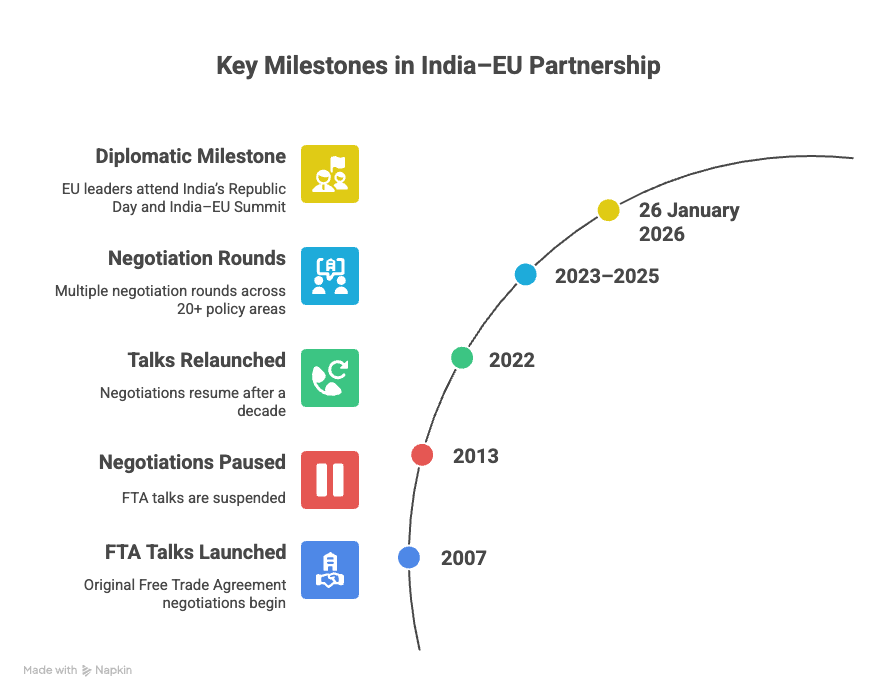
Negotiations on the India–EU Free Trade Agreement were relaunched in 2022 after a prolonged pause. Since then, both sides have worked through multiple negotiation rounds covering over twenty policy areas, including goods, services, investment protection, customs cooperation, intellectual property, and sustainable development.
Recent discussions in late 2025 and early 2026 have focused on narrowing differences on market access, regulatory alignment, and rules of origin. Officials on both sides have indicated that political will is now firmly aligned to push the agreement toward closure.
European Trade Commissioner Maroš Šefčovič recently stated,
“We are working with strong political momentum to conclude an ambitious and balanced agreement that reflects the scale of the EU–India partnership.”
German Chancellor Friedrich Merz, during his India visit earlier this year, reinforced this sentiment, highlighting the FTA as a cornerstone of Europe’s long-term engagement with India.
If concluded, the agreement is expected to significantly expand trade flows, improve investment certainty, and strengthen supply chain diversification for both economies.
Republic Day Diplomacy Signals a New Chapter
Adding symbolic and strategic weight to these negotiations, European Commission President Ursula von der Leyen and European Council President António Costa are scheduled to attend India’s Republic Day celebrations on 26 January 2026.
This marks only the second time India has invited leaders of a regional bloc as chief guests for the national event, underscoring the growing importance of the EU in India’s global outlook.
The visit coincides with the India–EU Summit, where trade, security cooperation, climate commitments, and technological collaboration are expected to feature prominently.
In a recent statement, Ursula von der Leyen observed,
“Europe and India are natural partners in shaping a stable, sustainable, and rules-based global order.”
Beyond Trade: A Broader Partnership
While the FTA remains a central focus, the India–EU relationship is no longer defined solely by commerce. Cooperation spans digital public infrastructure, clean energy, critical technologies, mobility, education, and people-to-people ties.
As both sides navigate shifting global alliances and economic uncertainty, the partnership is increasingly viewed as a strategic anchor for stability and growth in the Indo-European corridor.
The convergence of trade negotiations and high-level diplomacy suggests that India and the EU are positioning their partnership for a long-term, future-oriented trajectory.