

Indian Succession Laws 

What is Succession Law? 

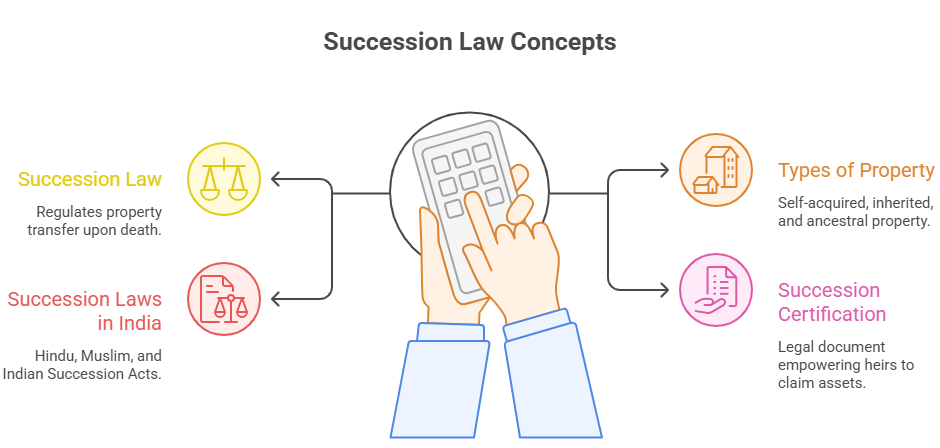
Succession law regulates how a person’s property, debts, and titles are transferred to others upon their death. It dictates the legal process for distributing assets, whether through a Will (testamentary) or via laws of inheritance when no Will exists (intestate), and is crucial for validating ownership transfer.  
  • Intestate Succession: Rules followed when someone dies without a valid will, typically distributing property among close relatives like spouses, children, and parents. 
  • Testamentary Succession: Governs the creation and execution of a will, allowing individuals to dictate asset distribution. 

    Types of Property 

    • Self-Acquired Property: This refers to property acquired by an individual through their own efforts, investments, or income. The owner has the absolute right to bequeath this property as they wish. 
    • Inherited Property: This is property received from a deceased person. The rights of heirs to this property depend on the laws governing succession applicable to the deceased. 
    • Ancestral Property: This refers to property inherited from ancestors up to four generations. In many cases, ancestral property cannot be sold or divided without the consent of all coparceners. 

    Succession laws in India: 

    • Hindu Succession Act (1956) – For Hindus, Sikhs, Buddhists, and Jains 
      • Class I Heirs (spouse, children, mother) inherit first. 
      • Class II Heirs (father, siblings, extended family) inherit if no Class I heirs exist. 
    • Muslim Personal Law (Sharia) – For Muslims 
      • One-third of the estate can be willed freely. 
      • The rest follows Islamic inheritance laws. 
    • Indian Succession Act (1925) – For Christians, Parsis 
      • Spouse and children inherit equally. 
      • If no spouse or children, parents inherit. 

    What is Succession Certification? 

    A succession certificate is a legal document issued by a civil court under the Indian Succession Act, 1925 that empowers legal heirs to claim and manage the movable assets (bank accounts, shares, insurance) and debts of a deceased person who died without a will. It protects beneficiaries from disputes and establishes legitimate ownership of financial assets.  

    How to obtain Succession certificate? 

    • Draft a Petition: Apply to the district judge holding jurisdiction over the deceased’s residence. 
    • Required Documents: Death certificate, proof of relationship, list of legal heirs, and inventory of assets/securities. 
    • Court Verification: The court will issue notices to the public and potential legal heirs to check for objections. 
    • Issuance: Upon successful verification, the court grants the certificate.