

For Non-Resident Indians (NRIs) residing in the USA, bringing family members—such as spouses, children, or elderly parents—requires navigating the US’s immigration system. This guide outlines the key considerations, eligibility criteria, financial requirements, work rights, and recent policy changes as of May 2025.
Under US immigration rules, dependents typically include:
Eligibility and application routes vary based on the visa status of the NRI sponsor (e.g., Skilled Worker, Student, British citizen, or Indefinite Leave to Remain holder).
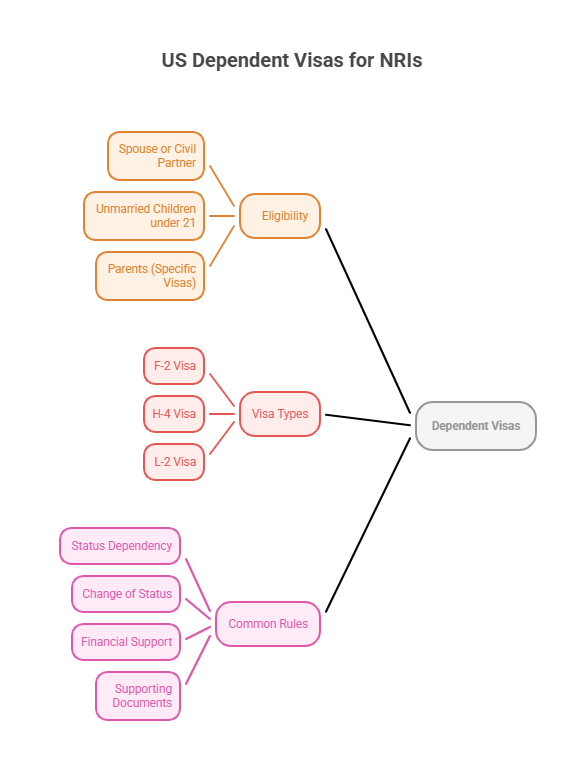
| Visa Type | Principal Visa Holder | Who Can Apply as Dependent | Work Rights | Study Rights | Key Notes |
| F2 | F1 (Student) | Spouse & unmarried children under 21 | Not allowed | Children (K–12) Spouse full-time college | Status tied to F1; financial proof required |
| H4 | H1B (Specialty Worker) | Spouse & unmarried children under 21 | Limited – allowed only if H1B has approved I140 or meets specific conditions | Allowed | No automatic work rights; depends on principal’s immigration process |
| L2 | L1 (Intra-company Transfer) | Spouse & unmarried children under 21 | Spouse can work (auto or with EAD); Child cannot | Allowed | Generally favorable; work easier than H4 |
The dependent’s status and validity depend on the principal visa-holder maintaining valid status. If the principal visa status ends, the dependents’ status typically must end (or they must change to another status).
For a dependent already in the U.S. on another visa/status, a “change of status” might be necessary to move to the dependent status.
Financial support is required — the principal visa holder (and/or the institution) may need to show sufficient funds to support dependents.
Applicant would need to show supporting document (like marriage or birth certificates) while applying or the dependent visa.